Showing posts with label river boat. Show all posts

Tuesday, 11 December 2012

The Queens College Barge Air Conditioning Heat Pump


Installation of Mitsubishi air conditioning heat-pump on the Queens College Barge, Oxford

Orion air conditioning & refrigeration ltd has complete the installation of a  Mitsubishi Heavy Industries Air Conditioning Wall air conditioning heat-pump heating system on the Queens College Barge which is now a private house boat for a well known television broadcaster. The wall unit was installed in the bedroom area of the barge which was being heated by low efficiency fan heaters. This type of heating is expensive to run in comparison to heat pumps which can be up to 5 times more efficient.

History of the Queens College Barge, Oxford

The Queens College Barge was a bit of history from the late 19 century with some unique characteristic such as the eagles head on the front. The barge was used for the Queens college rowing team up to the 1960's where it was used as a viewing point for watching the rowing races of the day. Some pictures can be found dating back to the 1890's on race days. It was now moored on a beautiful bank of the river Thames close to Oxford town centre with some amazing views of the river and its wildlife.
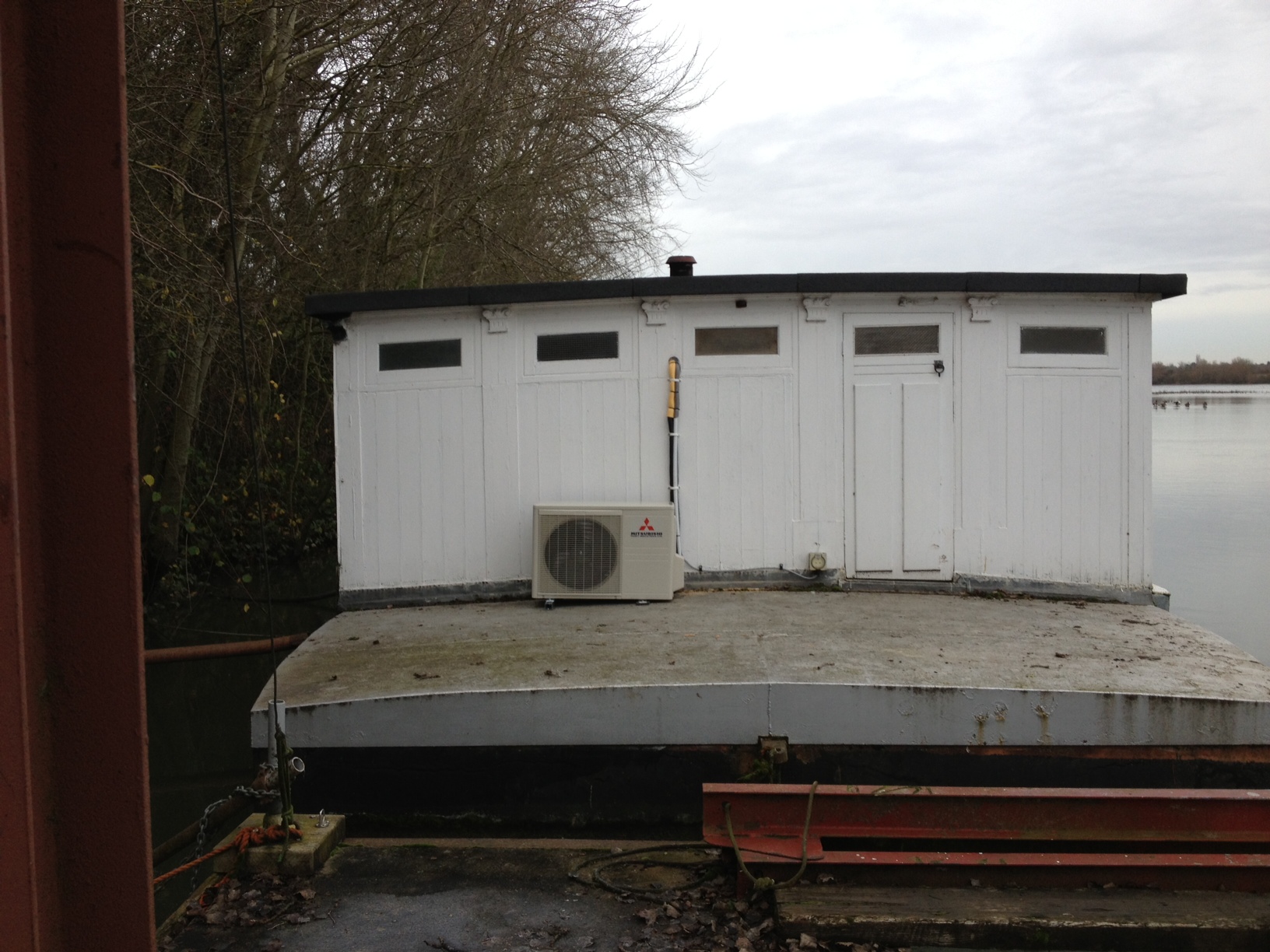


What air conditioning heat-pump was installed


For a list of our client have a look at our About Us section

Call:             +44(0)845 5677080                
E-mail: Info@orionair.co.uk

'via Blog this'

Monday, 9 May 2011

Using river water to heat a river boat?

River water can be utilised to heat a boat and in the past systems using copper coils in the water have been used in conjunction with heat pumps. However, rules and regulations and the lack of available manufactured equipment have made this type of system less attractive.


Pumping river water through a heat pump can give very good results, but heat pump units require water at temperatures above 5 to 8°C (varying depending on type). Whilst delivering very high-efficiencies for much of the time, this system may fail to operate in the middle of winter during lower temperatures- just when you need the most heat, so a back-up heat source is usually advisable.

Oxygen and contaminants in the river water may also be a concern in some circumstances, causing pump failure and possibly a system refrigerant leak. But don't let me put you off; this system can give excellent results if installed correctly.

For those lucky enough to have a spring, this is a much more stable and better heat source. Its an opportunity not to be overlooked, offering excellent efficiencies. Again, acidity and impurities in the water can sometimes make its use prohibitive, but some heat pump units will tolerate ‘corrosive’ water (some Dimplex models etc). A possible alternative is to use an intermediate heat exchanger in such circumstances. However, the added temperature drop and necessary extra pump can reduce the performance considerably.

The water source should ideally be fairly close to the property, and should not require pumping up any significant height or the power for pumping it may detract from the energy savings. Having said that, water could be taken over considerable distances if the pipe diameter is big enough, especially in a downward direction. It is a relatively simple exercise to calculate the pump power required (if any) to get the water to and through the heat pump unit.

Permission should be sought from the relevant authorities as an abstraction licence may be needed.

Produced by John Cantor